



Thinking Like a Mathematician
How to Understand RNG, Maximize Returns, and Apply Strict Financial Discipline in Slots
When entering a casino or opening an online gaming platform, many people see slot machines as purely luck-based “point-and-shoot cameras” of gambling. Some even firmly believe in street myths, such as: “This machine hasn’t paid out a jackpot in a long time, so the next spin must be a sure win,” or “You can observe the rhythm of the reels and find a pattern to time your button presses.”
However, the hard truth that casinos least want you to confront is this: modern slot machines cannot be manipulated through any form of “operational skill” or physical trickery.
If you truly want to “win” at slots (or more accurately, maximize returns and minimize losses), you cannot rely on vague luck. Instead, you must think like a mathematician—understand the underlying random number generation mechanism, choose games using probability logic, and apply strict financial discipline to overcome your own greed.
I
Core Strategy: Finding a Mathematical “Asymmetry Advantage” in Slots
Since you cannot change the machine’s algorithm, you must proactively choose the most favorable machine before sitting down.
1. Focus on RTP (Return to Player)
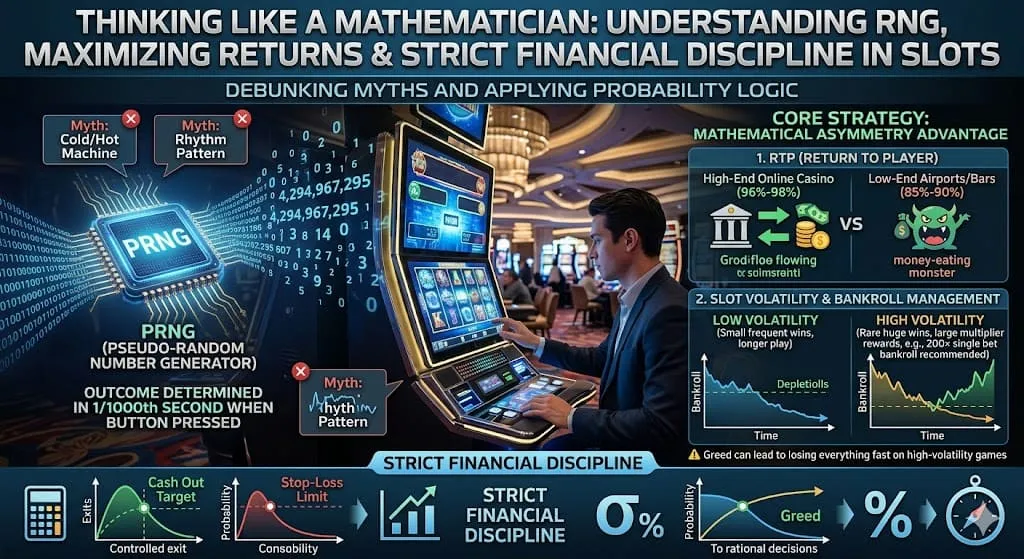
RTP (Return to Player) is the most important parameter of a slot machine. It represents the theoretical percentage of total wagered money returned to players over long-term operation.
Avoid low-end machines:
Those found in airports, bars, casino walkways, or cruise ships with RTP only around 85%–90% (often called “money-eating monsters”).
Look for high-end machines:
Prefer machines with RTP between 96%–98% or higher (more commonly found in online casinos). This means that in the long run, for every 100 units wagered, you theoretically lose only 2–4 units. This significantly extends your survival time and increases your chance of reaching bonus rounds.
2. Choose Based on Your Bankroll: Slot Volatility
Volatility determines the “personality” of a slot machine’s payouts, directly affecting how long your bankroll lasts:
Low volatility:
Frequent wins but small payouts. Suitable for players who want longer playtime and stable, conservative betting with limited bankroll.
High volatility:
Rare wins (long periods of nothing), but when wins occur, they are very large (including high-multiplier rewards). Suitable for risk-takers with sufficient bankroll seeking big hits (recommended bankroll: at least 200× the single bet).
II
Decoding the Brain of Slots: The RNG (Random Number Generator)
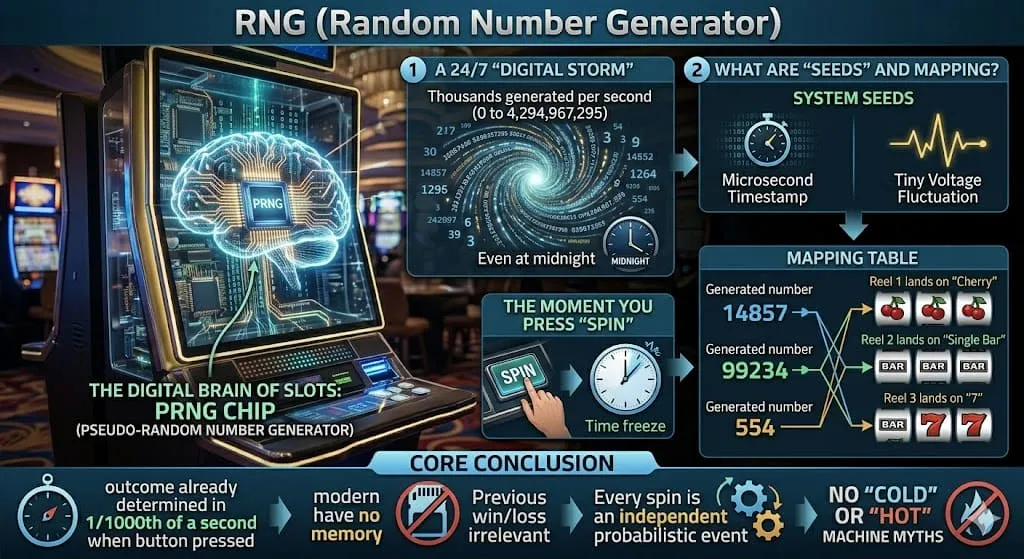
To master the game, you must understand the digital brain of the machine. Modern slots rely entirely on a PRNG (Pseudo-Random Number Generator) chip to ensure complete unpredictability.
1. A 24/7 “Digital Storm”
There are no physical reels inside modern slot machines. What you see on screen is purely animation. Once powered on, the RNG microprocessor continuously generates random integers between 0 and 4,294,967,295 at speeds of thousands or even tens of thousands per second. Even at midnight when nobody is playing, numbers are still being generated at full speed in the background.
2. What Are “Seeds” and Mapping?
A PRNG is essentially a deterministic mathematical formula. Given an input value (a seed), it produces an output number. To ensure unpredictability, modern machines often use system microsecond timestamps—or even tiny fluctuations in system voltage—as the initial “seed.”
The moment you press the “Spin” button, the RNG’s current state is frozen at that microsecond, and the generated number is fed into a mapping table:
Generated number 99234 → Reel 2 lands on “Single Bar”
Generated number 554 → Reel 3 lands on “7”
Core conclusion:
Although the reels spin visually for 3 seconds, the outcome is already determined in the thousandth of a second when you press the button. Most importantly, modern slots have no memory. They do not remember whether the previous spin was a win or a loss. Every spin is an independent probabilistic event—there is no such thing as a “cold machine” or “hot machine.”
III
Hackers vs Mathematicians: Do Slot Machine Exploits Really Exist?
Since they are called “pseudo-random,” it means they are generated by deterministic mathematical algorithms. In theory, if you know the exact formula and can determine the current “seed,” you could predict the next outcome. Historically, some people have indeed exploited such vulnerabilities. One famous case occurred around 2014 in Russia:
The Novomatic Slot Machine Hack Case (Russia)
A hacker team in St. Petersburg purchased large numbers of old slot machines and reverse-engineered their circuit boards. They discovered that the seed heavily depended on the machine’s internal system timestamp.
They sent “agents” into casinos worldwide to secretly record slot machine spins using mobile phones, sending footage back to headquarters. Mathematicians then analyzed the timing of jackpot symbols to reconstruct the machine’s internal timestamp state.
Their app would then vibrate at a precise moment—0.25 seconds before a “perfect microsecond” occurred. The agent would press the button exactly at that moment, triggering massive winnings totaling millions of dollars.
How Modern Casinos Have Closed These Loopholes
Trying to replicate this today is nearly impossible due to advanced countermeasures:
Use physical phenomena like thermal noise or photon behavior as seeds, which are fundamentally unpredictable in the universe.
Use military-grade algorithms (e.g., AES-256). Even if you record one billion outcomes, it is mathematically impossible to reverse-engineer the next state.
Many modern slot machines are just “screens.” All calculations are performed on heavily secured casino backend servers.

IV
Advanced Practical Play: Breaking Gambling Fallacies and Psychological Traps
Since the algorithm cannot be broken, your actual performance depends entirely on bankroll management and psychological discipline.
1. Set Hard Stop-Loss and Take-Profit Limits
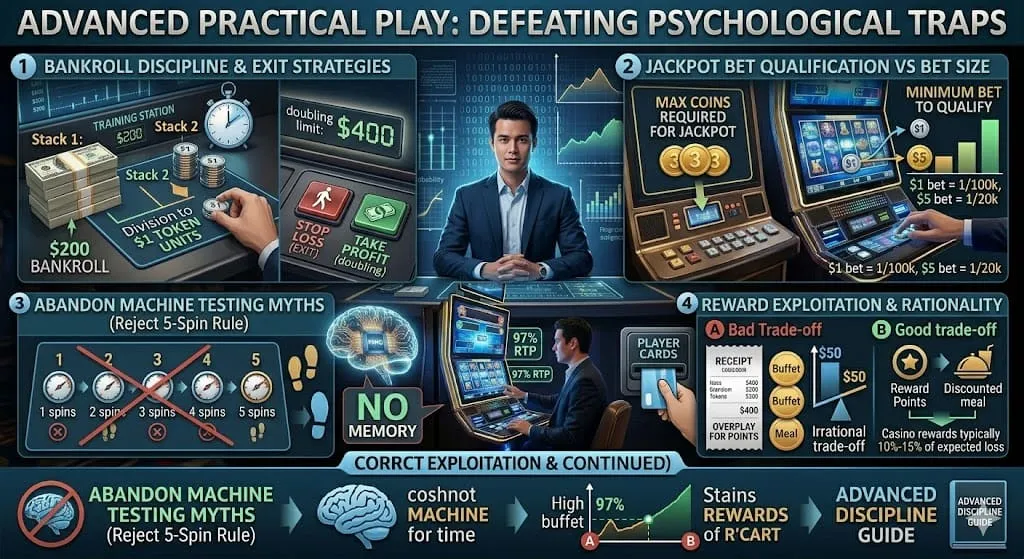
This is the only real risk control method. Before entering, divide your bankroll into units (e.g., $1 bets with a $200 bankroll).
If you lose it all, stand up and leave immediately. Never chase losses.
Set a win target (e.g., doubling to $400) and cash out immediately upon reaching it.
In a negative expected-value game, reducing play time and exiting early is the only way to preserve capital.
2. Rational Understanding of Jackpot Bet Requirements
Do not blindly always choose “Max Bet.”
Traditional machines:
Some require max coin bets to activate jackpots.
Modern video slots:
Jackpot probability is often proportional to your bet size (e.g., $1 bet = 1/100,000 chance; $5 bet = 1/20,000 chance).
You only need to meet the minimum required bet to qualify for jackpots. Max betting with limited funds only accelerates bankruptcy.
3. Abandon the “Machine Testing” Myth (Reject the 5-Spin Rule)
The popular “5-spin test rule” (if no win in 5 spins, switch machines) is mathematically meaningless. RNG has no memory, and switching machines does not change your probability.
Correct approach:
Once you choose a machine that fits your budget and has a high RTP, stay on it. Frequent switching only increases time spent in the casino and total bets placed unintentionally.
4. You Can Exploit Rewards, But Don’t Overpay for Them
Always insert your player card when playing slots. Casinos reward players with meals, hotel discounts, or cashback based on wagering volume.
However, realistically:
Casino rewards typically represent only 10%–15% of your expected loss.
Never overplay just to earn points. Spending $400 extra to get a $50 buffet is a classic irrational trade-off.
V
Beware of the Casino’s Two Major “Hallucination Traps”
Casinos use psychology within legal frameworks to manipulate perception:
Machines often show outcomes where two jackpot symbols align and the third is just slightly off. Psychologically, this triggers dopamine and creates the illusion that “I was so close.” In reality, mathematically, “almost winning” and “far from winning” are identical. A loss is a loss.
You bet $5, the machine lights up, plays celebratory music, and declares you “won $2.” Wake up—you actually lost $3. Do not let audiovisual effects distort your perception of profit.
Final Summary
The perfect winning formula in slot machines is not about defeating the chip—but defeating yourself:
Perfect exit formula = High RTP selection + bankroll-appropriate volatility + immediate withdrawal after hitting a win target
Casinos play a psychological game. Machines never get tired, algorithms never make mistakes—but humans do. Those who can cut losses decisively and walk away when winning are the only true “counter-algorithm” to the system.