

Quick Answer
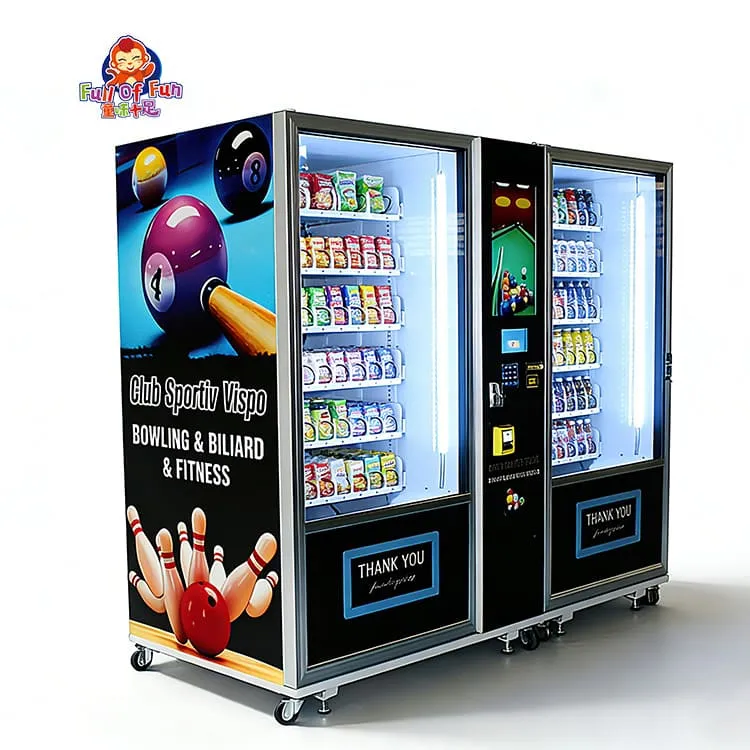
For a standard snack-and-drink vending machine, at the industry-average net profit of $300–$400 per machine per month, you would need roughly 20–28 machines to reach $100,000 in annual profit. If your machines are at the lower end of the industry range ($100–$200/month), you would need 40–80 machines. If your locations are excellent and well managed ($500–$800/month), as few as 13–17 machines can get you there. The number varies widely — and the real driver isn’t the machine count itself, but the quality of each location and how efficiently it’s operated.
1. What Factors Affect Vending Machine Revenue?
A lot of people ask “how much can one vending machine make?” — but there’s no single answer. Revenue is shaped by several variables. Here they are, ranked roughly by importance:
| Factor | What It Means | Impact on Revenue |
|---|---|---|
| Location | Foot traffic volume and whether the crowd is a “captive audience” (factories, hospitals, etc.) | Drives 70%–80% of revenue variation |
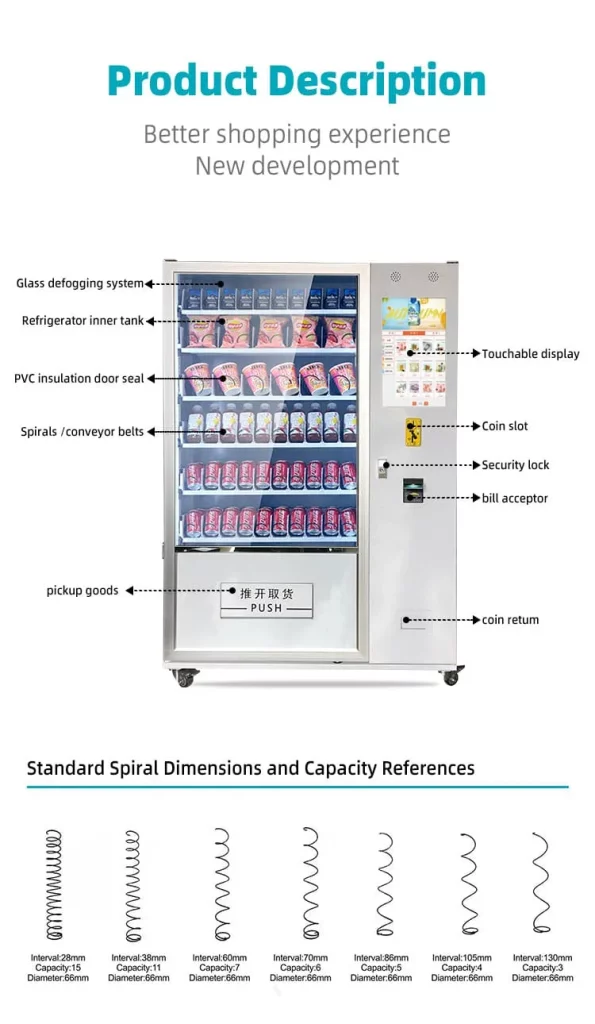
| Machine Type | Standard snack/drink machine, refrigerated fresh-food machine, or smart unattended retail kiosk | Affects average transaction size and margin |
| Product Mix | Whether the products match what that specific crowd actually wants | Affects repeat purchase rate and basket size |
| Payment Method | Whether card and mobile payment are supported | Increases transaction value, reduces lost sales |
| Restocking & Maintenance Frequency | Stockouts and machine downtime | Directly causes lost revenue |
| Commission Rate | Location owners typically take a 10%–25% cut | Directly eats into net profit |
In short: location sets the ceiling, and operations determine how close you get to it. The same machine placed in a factory break room versus a quiet residential street corner can see monthly revenue differ by 5x or more.
2. How Much Profit Can One Vending Machine Actually Make?
2.1 The Basic Profit Model for a Single Machine
The profit formula for a standard snack-and-drink vending machine is straightforward:
Combining widely cited industry figures, here’s what a typical machine looks like at each tier:
| Tier | Monthly Gross Revenue | Net Margin | Monthly Net Profit | Typical Location |
|---|---|---|---|---|
| Low traffic | $150–$300 | 15%–25% | $50–$150 | Small offices, quiet residential areas |
| Medium traffic (industry average) | $300–$600 | 20%–30% | $200–$400 | Standard office buildings, schools |
| High traffic / captive audience | $800–$1,500 | 30%–45% | $500–$800+ | Factories, hospitals, airports, 24-hour facilities |
Data note: These ranges are drawn from multiple industry analyses (including figures referencing NAMA industry data). Net monthly profit for standard machines generally falls between $100 and $500, with an often-cited industry “midpoint benchmark” of roughly $300–$400 per machine per month. High-traffic, captive-audience locations (large manufacturing plants, 24-hour facilities) can exceed $600.
2.2 Startup Costs and Payback Period
| Item | Cost Range |
|---|---|
| Machine purchase (new) | $1,500–$10,000 (standard snack/drink machines typically $3,000–$5,000) |
| Initial inventory cost | Approximately $200–$500 |
| Annual maintenance | $300–$1,000 |
| Annual license/insurance | $200–$800 |
| Typical payback period | 8–18 months (depending on location quality) |
3. How Many Machines Do You Need to Reach $100,000 in Profit?
This is the core question of this article. The math is straightforward:
Here’s the breakdown across three operating levels:
| Operating Level | Monthly Net Profit/Machine | Annual Net Profit/Machine | Machines Needed for $100,000 |
|---|---|---|---|
| Conservative (mediocre locations, light management) | $100–$200 | $1,200–$2,400 | ~42–83 machines |
| Industry average | $300–$400 | $3,600–$4,800 | ~21–28 machines |
| Excellent operations (great locations + active management) | $500–$800 | $6,000–$9,600 | ~10–17 machines |
3.1 A Concrete Reference Example
Let’s say your goal is to hit the strict industry-average benchmark:
- Monthly net profit per machine: $350 (midpoint)
- Annual net profit per machine: $350 × 12 = $4,200
- Machines needed for $100,000: $100,000 ÷ $4,200 ≈ 24 machines
This means that if you can maintain roughly $350/month in net profit per machine, around 24 machines would get you to a $100,000 annual profit target.
3.2 More Machines Isn’t Always Better — Quality Beats Quantity
A common misconception in this industry is “more machines = more money.” In reality:
- 20 machines in excellent locations (at $500/month each) = $120,000 annual profit
- 50 machines in average locations (at $200/month each) = $120,000 annual profit
Both scenarios produce the same profit, but the second one requires far more in operating costs, driving mileage, labor, and breakdown management. This is exactly why experienced operators tend to prioritize location quality over simply scaling up machine count.
4. Profit Comparison Across Different Fleet Sizes
| Number of Machines | Annual Profit at Industry Average ($350/machine/month) | Annual Profit at Excellent Operations ($650/machine/month) |
|---|---|---|
| 5 | $21,000 | $39,000 |
| 10 | $42,000 | $78,000 |
| 20 | $84,000 | $156,000 |
| 24 | $100,800 | $187,200 |
| 30 | $126,000 | $234,000 |
| 50 | $210,000 | $390,000 |
As you can see, machine count and location quality multiply each other — with the same 24 machines, the gap between operating levels can nearly double your annual profit.
5. Six Ways to Reach $100,000 Faster
- Prioritize “captive audience” locations: Factory floors, hospitals, 24-hour warehouses — people there have no alternative purchase options, which naturally raises basket size and repeat purchases.
- Support mobile/cashless payment: Directly boosts conversion rate and reduces lost sales from customers who don’t have cash on hand.
- Match the product mix to the location: Offices do well with coffee and healthy snacks; factories do better with high-calorie, filling foods and drinks.
- Control your commission rate: Every 5-percentage-point increase in commission can cut net profit by more than 10% — pay close attention to this in negotiations.
- Use data to guide restocking schedules: Avoid both extremes — restocking too early (wasted labor) and restocking too late (lost sales from stockouts).
- Lower fixed costs through direct factory sourcing: Cutting out middleman markups directly improves net margin and shortens the payback period per machine.
6. Frequently Asked Questions
Q1: What’s the lowest a standard vending machine can earn in a month?
In a poor location, monthly net profit can be as low as $50–$150. This is exactly why site selection is considered the single most decisive factor.
Q2: As a beginner, how many machines should I start with?
Industry convention is to start with 1–2 machines to validate your location and operating process, then scale up gradually — rather than buying a large batch of machines all at once.
Q3: Should I buy new or used machines?
New machines typically run $3,000–$5,000 and come with better warranty coverage and reliability. Used machines are cheaper (as low as $1,500 in some cases) but may carry higher breakdown rates and maintenance costs — you’ll want to calculate total cost of ownership, not just sticker price.
Q4: To hit $100,000, is more machines always better?
No. Machine count is just one variable in the formula — location quality and operational efficiency matter just as much, if not more. 20 machines in great locations can outperform 50 machines in average ones.
Q5: What’s a typical commission rate for location owners?
The common industry range is 10%–25%. Owners of high-traffic, premium locations (such as large factories) tend to have more negotiating leverage, so their commission may sit toward the upper end.
Q6: How long does it typically take to break even?
For a standard snack/drink machine in a mid-to-high traffic location, the payback period is generally 8–18 months, depending on foot traffic and pricing strategy.
7. Summary
There’s no single fixed number that answers “how many vending machines do I need to make $100,000?” — but there is a clear formula:
- At the industry average (roughly $300–$400/machine/month), you’d need approximately 20–28 machines.
- What actually determines that number isn’t “how many machines you buy” — it’s location quality, product fit, and operational management.
Rather than chasing a machine count from day one, a more reliable path is to start small — run 3–5 machines in high-quality locations first, validate what net profit per machine you can sustain, then use that real number to calculate the fleet size you actually need. That gives you a number you can actually execute against, instead of one that only works on paper.
Data note: The figures in this article are compiled from multiple 2026 industry analyses and publicly available operator data (including statistics referencing NAMA and IBISWorld), intended to illustrate the calculation logic and general ranges involved. Actual earnings vary significantly based on location, products, and operating quality — we recommend running the numbers against your own specific locations.